The courtroom smelled faintly of polished wood and stale coffee, a scent that seemed to linger in the heavy air as if it, too, were waiting for judgment to fall. Sofia Martinez stood at the defendant’s table, her hands trembling slightly though she kept her posture straight. Across the aisle sat Victoria and Richard Harrison, impeccably dressed in tailored suits that reflected their wealth and influence. Their expressions were carefully composed—wounded dignity mixed with quiet outrage. Cameras loved faces like theirs.
The prosecutor rose and spoke with deliberate precision.
“The Larkspur Emerald,” he announced, pausing to let the words settle. “Valued at four point two million dollars. Disappeared from the master bedroom of the Harrison residence. The security code was known to only three individuals: Mr. Harrison, Mrs. Harrison, and the housekeeper who had been trusted for twelve years.”
The jurors exchanged glances that suggested the story had already formed in their minds. It seemed almost too convenient. Sofia’s sick mother in Manila. Mounting medical bills. Years of loyal service in a mansion filled with priceless art and jewels. And now, a betrayal.
“I didn’t do it,” Sofia said softly, but her voice was nearly swallowed by the dry shuffle of legal papers and whispered commentary.
Her court-appointed attorney avoided her gaze, as if bracing for the inevitable. The judge adjusted his glasses and leaned forward.
“Miss Martinez, would you like to make a statement?”
Sofia stood slowly, her knees weak beneath her. She turned to look at Victoria—the woman whose children she had helped raise, whose home she had maintained as if it were her own.
“Do you truly believe I’m capable of this?” she asked, her voice steady despite the fear tightening her chest.
Victoria’s eyes turned cold.
“We trusted you with everything,” she replied. “And you betrayed us for money.”
The words struck harder than any accusation. Sofia lowered herself back into her chair, feeling as though the verdict had already been delivered.
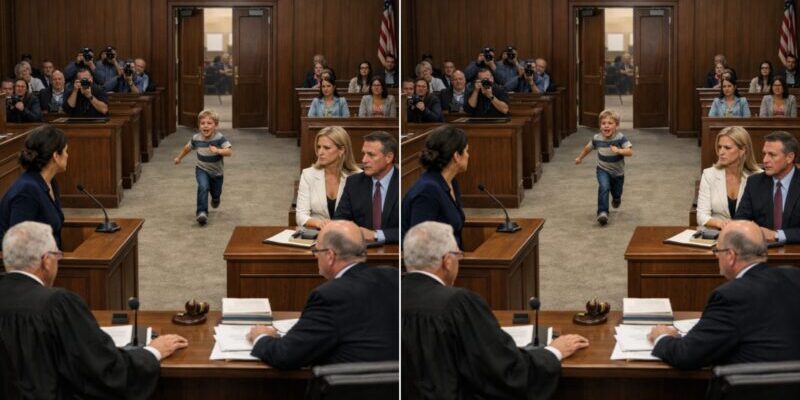
Then, suddenly, the courtroom doors burst open.
“Lucas! Come back here right now!” a nanny’s voice called out in panic.
Six-year-old Lucas Harrison ran down the aisle, his small face flushed and streaked with tears.
“It’s not true!” he cried out. “She didn’t take the emerald! I know what happened!”
A collective murmur rippled through the courtroom. Camera flashes lit up the room in rapid bursts.
“Lucas!” Victoria gasped, rising from her seat, her polished composure cracking for the first time.
But the boy was already standing in front of Sofia, as though shielding her. His words tumbled out unevenly, but each sentence landed with unmistakable force. He described how his father had hidden the emerald behind a painting of galloping horses. He spoke of a secret wall compartment. He remembered overhearing tense phone calls about debts and threats.
The courtroom fell into stunned silence.
Richard Harrison’s face drained of color, then flushed deep red.
“That’s absurd!” he snapped. “He’s confused. He’s just a child.”
Yet the panic flickering in his eyes betrayed him more than any argument could.
The judge quickly instructed the bailiffs to hold Richard in place. In the struggle, the sleeve of his expensive jacket tore at the seam, the fabric ripping as though his carefully crafted reputation were unraveling along with it.
Within the hour, everything shifted. Investigators were dispatched to the Harrison estate. The painting was removed. Behind it, concealed in a wall compartment, the emerald was discovered exactly where Lucas had described.
The prosecution’s case collapsed.
Right there in the courtroom, Sofia Martinez was cleared of all charges. The judge formally dismissed the accusation, acknowledging that the evidence no longer supported the claim against her.
Outside, a crowd of reporters waited eagerly, microphones raised and cameras poised. Yet Sofia paid little attention to the commotion. Her focus remained on Lucas, who clung tightly to her hand as if afraid she might disappear.
In the days that followed, the scandal deepened. Financial records revealed that Richard Harrison had been struggling with significant debt. The emerald had been intended as collateral in a desperate attempt to secure funds. Blaming Sofia had been a calculated effort to divert suspicion.
When renowned civil attorney Daniel Reed stepped forward to represent Sofia, his calm smile signaled that the legal battle was far from over. Defamation, wrongful termination, emotional distress—the list of claims grew longer with each review of the case. What had begun as a theft accusation now threatened to dismantle the Harrison family’s public image.
Six months later, the once-grand Harrison mansion was placed up for auction. Richard received a prison sentence for fraud and filing a false report. Victoria quietly relocated out of state, her social calendar and charitable appearances abruptly erased from the headlines.
Sofia, meanwhile, stood once more inside the now-empty house. She wore a tailored blue suit, her posture composed, her expression thoughtful rather than bitter. She had returned not for closure, but for a final inspection before ownership formally changed hands.
That morning, she had received an envelope. Inside were not merely documents detailing a financial settlement—though substantial compensation had been awarded—but legal papers regarding custody of Lucas.
In the aftermath of the trial, it had become clear that Lucas felt safest with the woman who had cared for him since infancy. Social workers and legal experts agreed that stability and emotional security were paramount.
“Mom, let’s go,” Lucas said softly, no longer the frightened witness who had once stood in a courtroom filled with strangers.
Sofia squeezed his hand gently. She looked around the grand foyer one last time, remembering the years she had spent there—wiping away dust, soothing tears, celebrating birthdays, enduring silent judgments.
Then she calmly closed the door behind her.
What had begun as an accusation rooted in assumption and inequality had transformed into a lesson about truth and courage. A child’s honesty had dismantled a lie. A woman’s quiet dignity had withstood public scrutiny. And in the end, justice did not arrive through wealth or influence, but through bravery and persistence.
Sometimes, the smallest voice in the room carries the greatest truth.