The silence inside my truck felt heavier than any silence I had ever experienced before. During my years away on duty, I had known many kinds of quiet. There was the tense stillness before danger, the kind that sharpened every sense and made your heartbeat echo in your ears. There was the calm after long nights when exhaustion finally settled in. But this silence was different.
This was the quiet of suburbia.
Perfect lawns stretched neatly along the street. Sprinklers ticked rhythmically in the distance. Children’s bicycles rested against fences. Everything about the neighborhood looked peaceful, controlled, and safe. It was the kind of place parents chose because they believed nothing bad could happen here.
Yet as I sat in the pickup lane outside Crestview Middle School, something inside me felt uneasy.
I had been gone for five hundred and forty-six days.
Eighteen months of missed birthdays, frozen video calls that ended too soon, and text messages that slowly became shorter and less frequent. When Lily first started writing to me, her emails were full of excitement. She told me about art projects, friends at school, and the funny moments that filled her days.
But recently her messages had changed.
The words were fewer.
The excitement had disappeared.
My daughter was thirteen now, and something in the way she wrote made her sound smaller somehow. Quieter. As if a part of her confidence had faded while I was gone.
I tightened my hands around the steering wheel.
I hadn’t told Lily I was coming home early. I wanted to surprise her. I imagined the moment she would see me waiting, the way her face would light up before she ran across the yard like she used to when she was younger.
The final bell rang.
Within seconds, the doors of the school burst open and students poured outside in loud groups. Backpacks bounced against their shoulders while laughter and conversation filled the air. Some kids hurried toward waiting cars while others lingered on the lawn.
My eyes moved through the crowd automatically, the way they had been trained to do for years.
That was when I noticed something unusual.
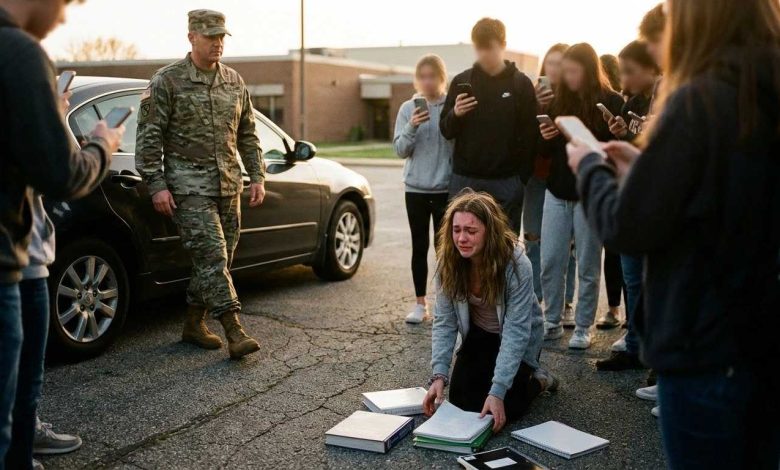
Near the far edge of the schoolyard, a group of students had formed a tight circle. Their bodies leaned inward, blocking the view of whatever stood in the center. Several phones were raised above their heads.
That wasn’t a group of friends talking.
That was a crowd watching something.
I opened the truck door and stepped out.
At first I couldn’t hear what was happening inside the circle. The noise of the schoolyard blurred together as I began walking across the grass.
Then the wind carried a sound that made my stomach tighten.
“Please… stop!”
The voice was small, desperate, and painfully familiar.
I knew that voice instantly.
It was the same voice that used to call for me when thunderstorms rattled the windows late at night.
It was Lily.
I was still several yards away when the crowd shifted slightly.
For the first time, I could see what was happening.
My daughter was on her knees in the dirt.
Her sketchbook—the one she carried everywhere—had been ripped apart. Pages filled with drawings were scattered across the ground like broken pieces of something fragile.
A boy stood in front of her, gripping her hair and pulling her head backward while a few others laughed and recorded the scene on their phones.
The laughter was loud.
Too loud.
For a moment everything around me slowed.
But I didn’t run.
I walked.
Step by step, I moved straight toward the center of the circle. Students turned when they noticed me approaching. The laughter began to fade as people shifted aside.
Within seconds I was standing in front of them.
The boy still held Lily’s hair in his hand.
I stepped forward until my shadow fell across both of them.
“Let go of my daughter,” I said.
My voice wasn’t raised.
It was calm, steady, and impossible to misunderstand.
The boy froze immediately.
His hand trembled before he released her hair and stepped backward.
For a moment the entire group stood in silence.
“Dad?” Lily whispered.
She looked up at me slowly, her eyes red and swollen. A small cut marked her lip, and dirt streaked across her cheek.
“Dad?” she said again, as if she needed to be certain.
I knelt down beside her and wrapped my arms around her shoulders.
“I’ve got you,” I told her quietly. “I’m here now.”
The moment my arms closed around her, the strength she had been holding onto disappeared. She buried her face against my chest and began to cry, deep shaking sobs that carried months of fear and exhaustion.
I held her tightly.
Around us, the crowd had gone completely silent.
After a moment, a member of the school staff finally approached. He walked slowly, as if unsure how to handle what he had just seen.
He cleared his throat.
“It looks like kids were just messing around,” he said awkwardly. “You know how teenagers are. Sometimes things get out of hand.”
He added that he hadn’t noticed anything earlier.
But later that evening, the truth came out.
One of the students uploaded the video that had been recorded during the incident.
The footage showed everything clearly.
It showed Lily on the ground, the boy pulling her hair, the students laughing—and the staff member standing nearby, scrolling on his phone while it all happened.
The next morning, I sat across from school administrators and several parents in a quiet conference room.
They spoke carefully about policies and procedures. They discussed the importance of handling the situation discreetly.
Then I connected my phone to the screen and pressed play.
The video filled the room.
No one spoke while it played.
When it ended, the silence was heavier than any explanation they could offer.
Within days, the staff member was removed from his position. The boy responsible for the bullying was suspended and required to attend counseling sessions.
But the most important change was the one I saw in Lily.
When she walked out of that school later that week, her posture was different. Her shoulders were no longer slumped with fear.
She walked beside me with quiet strength.
That day didn’t end with applause or dramatic speeches.
It ended with a simple understanding.
For years I had believed that my duty was somewhere far away, protecting people I might never meet.
But standing in that schoolyard, holding my daughter while the laughter faded into silence, I realized something that should have been obvious all along.
The most important battle I would ever fight wasn’t on some distant mission.
It was right there beside my child, refusing to stay silent when she needed me most.