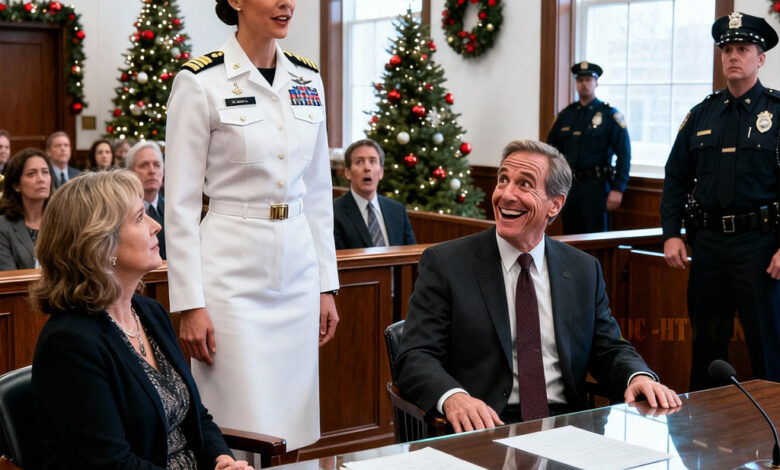
“Your Honor, I will defend her.” The sentence left my mouth with steady clarity, cutting cleanly through the thick, suffocating air of the courtroom. For a suspended moment, everything stopped. My father’s mocking grin froze mid-expression, caught somewhere between laughter and disbelief. His expensive attorney turned sharply toward me, eyes narrowing as he took in my tailored suit and the worn leather briefcase clenched in my hand. Even the bailiff hesitated, fingers hovering near the rail. This was the moment no one expected—the day the daughter he once dismissed as insignificant stood up and claimed the floor.
But the story had started earlier, outside the courthouse, where my mother sat silently in the passenger seat of my car. She gripped her purse like it was the last solid thing left in a world that had shifted beneath her feet. The building loomed ahead, all gray glass and tan brick, a place where lives were routinely dismantled by procedure and paper. The morning was cold and honest, the kind that stripped everything down to its bare truth. My mother wore her navy wool coat, something she’d bought after the divorce—something untouched by my father’s cologne or his expectations.
As we passed through security, she walked a half-step behind me, a habit formed over decades of being told her opinions came second. Today, that dynamic was about to change.
Courtroom 3B smelled faintly of old paper and floor polish. When we entered, I saw my father immediately, lounging at the defense table with effortless arrogance. His charcoal suit was flawless, his posture relaxed. Beside him sat the woman he’d replaced my mother with, polished and confident. On his other side was his attorney, silver-haired and self-assured, the kind of man accustomed to winning.
My father’s eyes slid past my mother dismissively before landing on me. He leaned toward his companion and murmured, “That country girl thinks she can sue.” He meant it as a private insult, but the room carried sound too well. My mother’s shoulders stiffened, and I felt the familiar surge of anger. I buried it, replacing it with focus.
We took our seats. I opened my briefcase and arranged the files—bank statements, property records, financial disclosures. Evidence I’d spent two years assembling. Across the aisle, my father smirked, clearly entertained. He didn’t know that while he’d been expanding his business, I’d been studying marital property law and forensic accounting.
The judge entered, a man known for precision and intolerance for dishonesty. The clerk read the case number. My father’s attorney stood first, delivering a confident introduction filled with phrases like “finalized settlement” and “baseless litigation.” He painted my mother as bitter and unreasonable. When he finished, the judge turned toward us.
“Counsel for the plaintiff?”
I stood. I stated my name and bar number clearly. The sound of my father’s breath catching was unmistakable. His head snapped up. “I represent the plaintiff,” I said calmly. “And the plaintiff is my mother.”
A murmur swept through the room. My father laughed sharply. “This is absurd.”
The gavel struck. “One more interruption and you’ll be held in contempt,” the judge warned. “Proceed.”
I began with a motion to reopen the divorce settlement based on newly discovered evidence of financial fraud. I presented documentation of undisclosed accounts, shell companies, and property purchases made under aliases. As I spoke, my father’s attorney lost his composure, flipping pages and whispering urgently. My father’s confidence drained away, replaced first by anger, then by fear.
The hearing stretched on. I called a forensic accountant who demonstrated that my father had deliberately undervalued his business to reduce support obligations. Objections were raised and overruled. I cited case law allowing reopened judgments when deception was involved. The judge listened carefully, his expression hardening with each revelation.
By closing arguments, the atmosphere had transformed. My father sat slumped, his suit suddenly ill-fitting. His partner avoided eye contact. I addressed the court one final time.
“Your Honor, trust is not a flaw to be exploited. My mother devoted thirty-two years to a marriage built on what she believed was honesty. The law exists to correct that imbalance when one party abuses that trust for personal gain.”
The ruling came two weeks later, but we knew the outcome long before. The judge ordered a full reassessment of assets, imposed penalties for nondisclosure, and required my father to cover all legal costs.
Outside the courthouse, my mother stood taller than I’d seen her in years. The wind lifted the hem of her coat as we descended the steps. My father caught up to us near the parking lot. He looked smaller somehow.
“I didn’t think you’d do this,” he said quietly.
I met his gaze. “That was your mistake,” I replied. “You taught me how to fight. You just didn’t expect me to fight for her.”
We walked away together, leaving him behind in the cold. Justice hadn’t been loud or dramatic. It had been deliberate, patient, and complete.