The journey home from military service is often described as a return to safety, a long-awaited reunion with normal life after months or years of danger. But for some veterans, the most painful battles do not end overseas. My name is Maya, and although I survived combat, the most shocking moment of my life happened not on a battlefield, but in a room filled with people who were supposed to honor me. I had returned from service changed, stronger in some ways and more fragile in others, carrying memories no one else could see. I had earned respect through sacrifice, yet to one person in my life, none of that mattered.
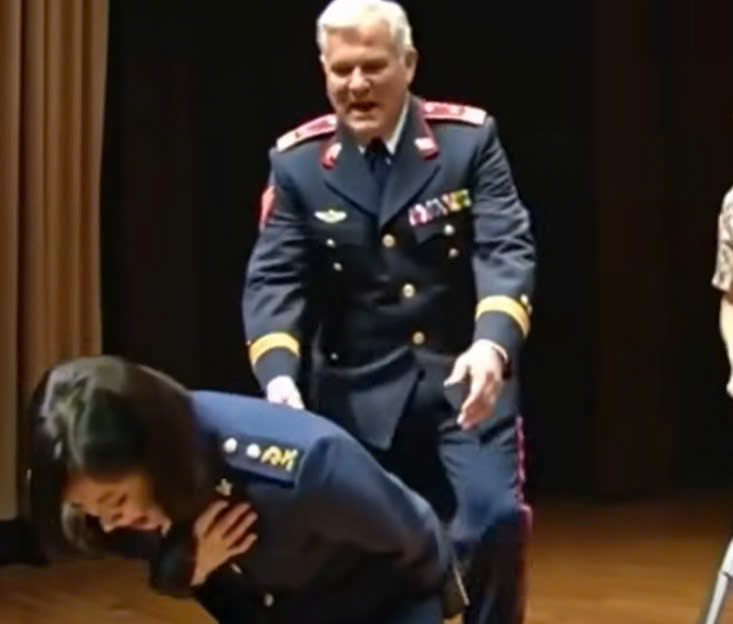
The day of my Purple Heart ceremony was meant to represent closure and recognition. The auditorium was formal and quiet, filled with the low murmur of conversation and the soft shine of polished shoes and pressed uniforms. The air carried a heavy stillness, the kind that comes before something important. Rows of service members sat at attention, their decorations catching the light. My father was there, reserved as always, his emotions hidden behind years of discipline. Beside him sat my stepmother, Linda, wearing a carefully practiced expression of pride that never quite reached her eyes.
As my name was read aloud and the citation described the explosion, the injuries, and the people I helped evacuate, I felt an overwhelming mix of pride and grief. I had survived, but others had not. The ceremony was supposed to honor that truth. I stood and began walking toward the stage, heart pounding, aware of every step echoing across the room. That was when everything changed.
Linda moved suddenly. There were no words, no warning, only motion. In a flash of anger that had clearly been building for years, she grabbed a nearby folding chair and swung it toward me. The impact was loud and shocking, a dull crack that echoed through the silent hall. Pain surged through my arm, sharp and disorienting, forcing me to stumble. Gasps rippled through the audience as confusion spread. I could hear people calling out, but for a moment everything felt distant, as if I were underwater.
Before anyone could react, uniformed officers were already moving. The atmosphere shifted from ceremony to crisis in seconds. My stepmother’s composure collapsed as she was restrained, her face registering the sudden realization that she had crossed a line she could never undo. The room buzzed with disbelief, then anger, then a collective resolve that what had just happened would not be ignored.
General Hayes stepped forward, his presence commanding immediate silence. His voice was steady, firm, and unmistakably protective. He spoke not just as a superior officer, but as someone who understood sacrifice. He made it clear that I was not alone, that no act of cruelty could erase what I had earned. His words cut through the chaos and restored order in a way only true leadership can.
As I stood there, struggling to stay upright, I felt hands supporting me, steadying me. The pain in my arm was intense, but something stronger pushed through it. The crowd began to clap, not politely, but with conviction. It wasn’t about ceremony anymore. It was about respect, solidarity, and standing up for someone who had been wronged. The applause grew until it filled the room, drowning out everything else.
With help, I returned to the podium. My arm throbbed, but my voice held steady as I spoke. I thanked those who had served beside me, those who had supported me, and those who understood that courage doesn’t always look heroic. Sometimes it looks like standing tall when someone tries to break you in front of everyone. I spoke for those who never made it home, and for those who came back carrying wounds no one could see.
When the ceremony finally ended, I was taken to the hospital. The doctors confirmed what I already knew: my arm was broken. As I lay there later that evening, staring at the sterile ceiling, I felt strangely calm. The physical injury would heal. What mattered more was the clarity I had gained. For years, I had carried the weight of someone else’s resentment, believing I had to earn my place in my own family. That day, I realized I no longer needed their approval.
The next morning, the Purple Heart sat on the table beside my hospital bed. It was heavy in my hand, not just with metal, but with meaning. It represented endurance, sacrifice, and survival. My stepmother’s actions had been meant to humiliate me, to diminish what I had accomplished. Instead, they revealed her bitterness and strengthened my resolve.
I understood then that family is not always defined by blood. Sometimes it is defined by shared struggle, by mutual respect, and by the willingness to stand beside one another when things fall apart. The people in that room, the soldiers, the officers, even the strangers who applauded, had shown me what real support looked like.
I left the hospital with a cast on my arm and a new sense of peace. I had survived war, betrayal, and public humiliation, and I was still standing. My uniform no longer felt like something I had to justify. It was proof of who I was and what I had endured. I was no longer carrying shame that didn’t belong to me.
I am Maya Porter. I am a veteran. I am a survivor. And no matter what obstacles come my way, I know now that I will always rise stronger than whatever tries to knock me down.