Three thugs knocked on the door of a solitary old man, convinced they had found an easy target. What they didn’t realize was who truly stood behind that door—or how their visit would end.
The three men had only recently been released from prison, but they had no intention of changing their ways. They went right back to what had sent them there in the first place. They searched for people who lived alone, intimidated them, and took whatever they wanted—homes, savings, dignity. They acted quickly, harshly, and without a trace of remorse.
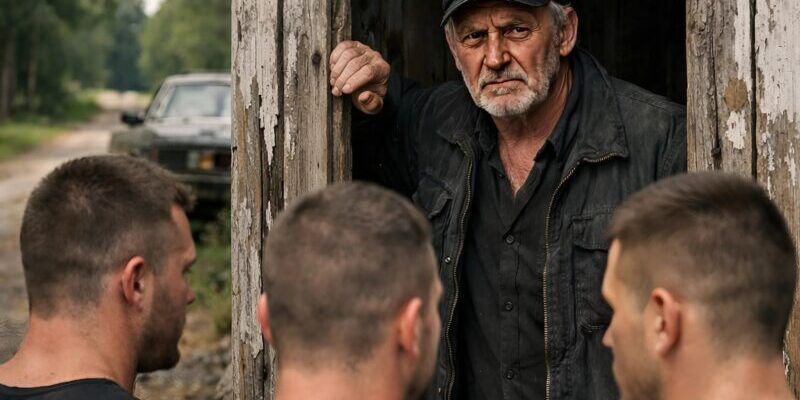
They had been watching the old man’s house for weeks. It sat at the corner of a quiet road on a large plot of land. The house was sturdy but aged, surrounded by open space with no close neighbors. They had done their homework. The old man had no family nearby. His daughter hadn’t spoken to him in years. She lived in another city and never came to visit.
An easy score, they decided.
That evening, as dusk settled in, they approached the gate and knocked on the door.
It opened to reveal an elderly man dressed in black, wearing a worn leather jacket. His face was calm. His eyes were steady and observant.
“You weren’t expecting us, but here we are,” one of the men said with a mocking grin.
The old man studied their tattoos, their tense shoulders, their arrogant expressions.
“What do you want?” he asked quietly.
“Your house. We’ll settle this the easy way.”
“No. Anything else?” the old man replied evenly.
“Listen, old man, we’ve made it clear. You hand over the house and we walk away. Otherwise, we’ll have to make this unpleasant.”
“Accept it,” another added. “You don’t have much time left anyway.”
The old man narrowed his eyes slightly.
“Are you stupid, or just hard of hearing?” he asked calmly.
“What did you just say?” one of them snapped, grabbing the collar of the old man’s jacket.
The old man didn’t flinch. His expression never changed.
“Forgive me, gentlemen. I didn’t quite understand who you were at first. Please, come inside. I’ll make some tea. While you’re here, I’ll gather the house papers.”
The men exchanged glances. In their eyes flickered satisfaction. They believed the old man had given in.
They stepped inside.
The old man closed the door behind them and quietly turned the key. The click of the lock echoed louder than it should have in the silent house.
“Go ahead,” he said, gesturing toward the couch. “Have a seat.”
They hesitated for a moment, then sat down. One sprawled out as if he already owned the place. Another positioned himself closer to the door. The third kept his eyes fixed on the old man.
The old man walked slowly to the door again, checked the lock once more, and turned back to face them.
“Good,” he said softly. “Now we can speak without witnesses.”
He sat down across from them. His back was straight. His gaze heavy and unwavering.
“Let’s start over,” he continued. “You don’t know me. I’m too old now for most people to remember. But your fathers? They remember me very well.”
The room grew still.
“Years ago,” he went on, “I held a certain authority in this neighborhood. I controlled it. I served time for serious matters. Not minor offenses. Serious ones.”
One of the young men forced a smirk.
“What, you trying to scare us with old stories?”
The old man didn’t raise his voice.
“You came into my home with threats. Without permission. Without understanding where you were stepping. That was your first mistake.”
He leaned forward slightly.
“The second mistake was assuming that old means defenseless.”
He slowly pointed toward the closed door of the next room.
“In that room,” he said, “is an arsenal beyond what you can imagine. If I chose to, none of you would walk out of here. Not at all.”
They were no longer smiling.
“I could make sure you regret the day you were born,” he added quietly.
His voice remained soft. That was what made it more unsettling.
“You have one opportunity,” he said. “Stand up. Apologize. Walk out of here. And forget this address.”
He looked at them steadily.
“Go ahead,” he said. “Check if you don’t believe me.”
The three men glanced at one another. The arrogance had drained from their faces. Doubt replaced it. And something else—uncertainty.
What if he was telling the truth? And if he wasn’t… was it worth finding out?
The one who had grabbed him earlier stood first.
“Let’s go,” he muttered to the others.
They moved toward the door.
The old man unlocked it and stepped aside.
“Good decision,” he said calmly.
The three men walked out without looking back. The gate shut behind them. Their footsteps faded quickly down the street.
Inside the quiet house, the old man remained standing for a moment. Then he walked slowly to the neighboring room, opened the door, and looked inside.
The room was nearly empty. No arsenal. No hidden weapons. Just old furniture covered in sheets and the faint scent of dust.
He closed the door gently.
Sometimes, strength isn’t about what you hold in your hands. Sometimes it’s about what others believe you’re capable of holding.
That night, the house remained exactly as it had been—solid, silent, and standing.