The small bell above the bakery door chimed softly as the woman stepped inside, almost as if even the sound was hesitant. She paused just beyond the entrance, letting the warmth wrap around her thin frame. It was the kind of warmth that didn’t just come from heating vents, but from ovens that had been working since dawn—sugar caramelizing, butter melting, bread rising to perfection.
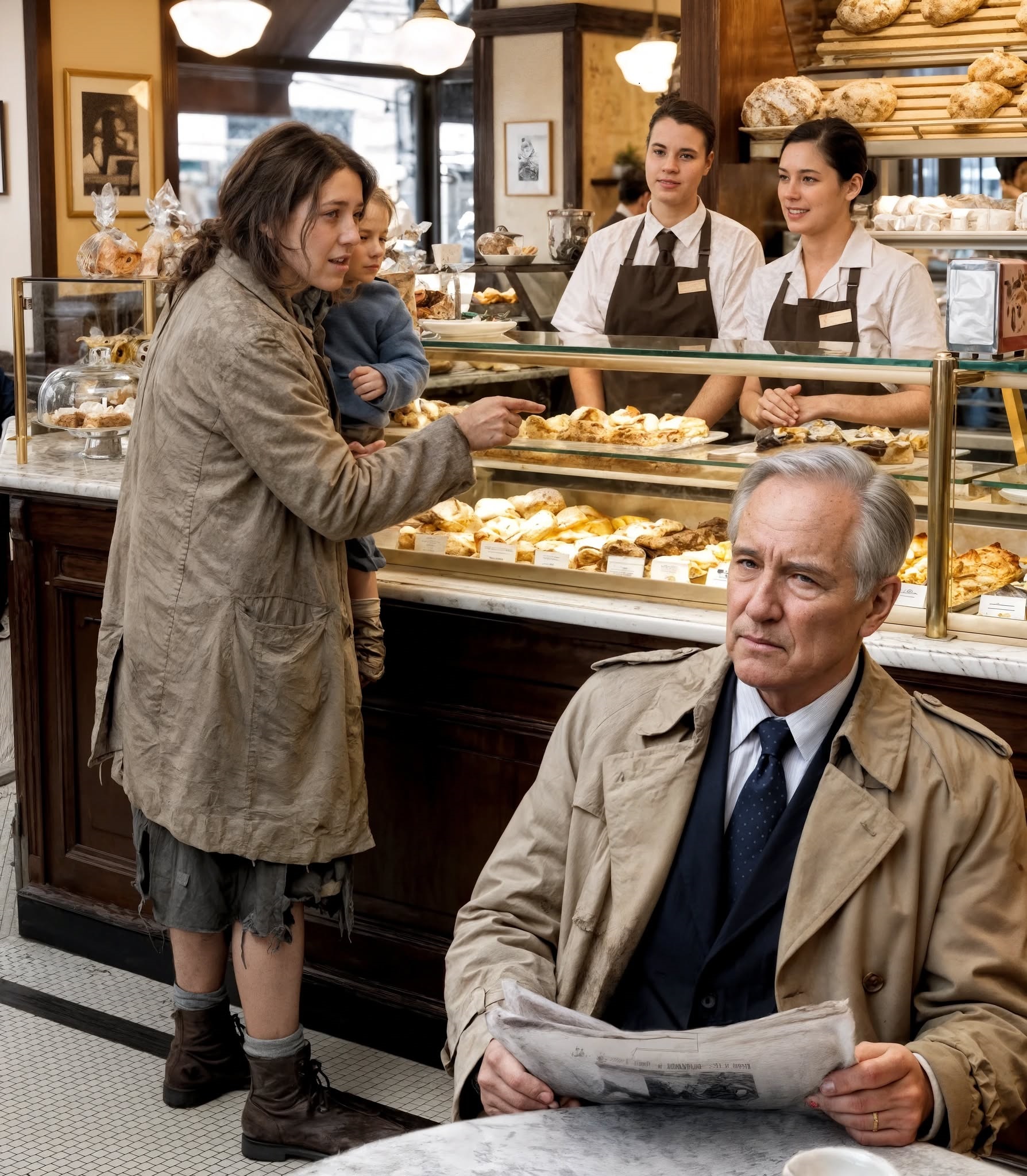
She looked like someone who hadn’t truly rested in weeks. Her coat was worn and frayed at the cuffs, stained from weather and wear, hanging loosely on her shoulders as if it belonged to another chapter of her life. Her boots were cracked, damp creeping through the seams. In her arms, she carried a little girl, no more than four years old, wrapped in a faded blue sweater. The child’s cheek rested trustingly against her mother’s shoulder.
The glass display cases glowed beneath golden lights. Cakes stood like trophies behind the glass—chocolate ganache dripping smoothly over layered sponge, fruit tarts arranged in perfect symmetry, éclairs lined up like polished jewels. It was a world of sweetness and order.
The little girl stirred.
“Mom…” she whispered, her eyes drifting toward the display. “Is that a birthday cake?”
The woman swallowed hard.
“Yes, sweetheart,” she answered softly. “Yes, it is.”
It was obvious she hadn’t intended to come in. Her fingers tightened around the strap of her worn canvas bag as she slowly approached the counter.
Behind the glass stood two young employees in crisp, spotless aprons. Moments earlier they had been laughing, leaning toward each other in easy conversation. The laughter faded the instant they noticed her.
She hesitated. Her voice, when it came, was barely louder than a breath.
“Excuse me,” she said gently. “I… I wanted to ask something.”
Her cheeks flushed as she forced herself to continue.
“Do you happen to have… an expired cake?”
The air in the bakery shifted.
“Expired?” one employee repeated, eyebrows raised.
“Yes,” she said quickly. “Something you were going to throw away. It’s my daughter’s birthday today. I don’t need anything fresh. Just… something sweet for her. If that’s not possible, I understand.”
For a brief second, there was silence.
Then came the smirk.
“A spoiled cake?” the young man laughed openly. “This isn’t a shelter.”
The woman flinched.
His coworker tilted her head and gave a thin smile. “We don’t sell trash here,” she added. “Try the dumpster in the alley. Maybe you’ll get lucky.”
A few customers shifted uncomfortably. One woman pretended to scroll through her phone. Another took a deliberate step away, distancing herself from the awkwardness.
The little girl lifted her head, sensing the tension.
“Mom?” she asked softly. “Did I do something wrong?”
“No, baby,” her mother said immediately, rocking her gently. “You didn’t do anything. Mommy just asked the wrong question.”
She lowered her gaze and turned toward the door, shoulders hunched beneath more than just the weight of her child.
Then a voice cut through the room.
“That’s enough.”
The employees froze.
Every head turned toward a man seated at a small corner table near the window. He had been quietly sipping coffee, dressed in a tailored coat that spoke of success without being flashy. His expression was calm—but firm.
He rose slowly.
“I’ve been sitting here for twenty minutes,” he said evenly. “And I just watched a mother ask for help in the most humble way possible. And I watched you mock her.”
The young man straightened defensively. “Sir, we have standards—”
“Yes,” the man interrupted. “Standards of decency.”
He walked toward the counter, his presence steady and controlled.
“What’s your name?” he asked the mother gently.
She hesitated. “Claire,” she replied quietly.
“And your daughter?”
“Emma.”
He crouched slightly so he could look at the little girl. “Happy birthday, Emma.”
The child blinked shyly.
The man turned back to the counter.
“I’d like the largest chocolate cake you have,” he said calmly. “And every candle in stock.”
The employees exchanged glances.
“And,” he added, reaching into his wallet, “I’d also like to purchase everything currently displayed in this case.”
The room fell silent again—this time in disbelief.
“Sir?” the cashier stammered.
“Everything,” he repeated. “Wrap it carefully.”
Within minutes, boxes were being stacked, receipts printed, hands trembling slightly as the order was prepared. The once-confident smirks had vanished.
When the cake was boxed and ready, the man turned back to Claire.
“This one is for Emma,” he said. “The rest will be delivered to the nearest family shelter.”
Tears filled Claire’s eyes.
“I can’t accept this,” she whispered.
“You can,” he replied gently. “Because today isn’t about charity. It’s about dignity.”
He knelt again in front of Emma and handed her the cake box.
“Every birthday deserves a candle,” he said softly.
The little girl smiled for the first time since entering the bakery.
One of the customers began to clap quietly. Another joined. Within seconds, the small bakery was filled with applause—not loud, but heartfelt.
The millionaire—because that’s who he was, a well-known local investor—turned to the employees one last time.
“You never know who’s watching,” he said calmly. “And more importantly, you never know who someone used to be—or who they might become.”
Claire stepped toward the door, holding the cake carefully. Before she left, she turned back.
“Thank you,” she said, her voice steady now.
The bell above the door chimed again as she stepped into the cold evening air, her daughter’s laughter echoing softly behind her.
Inside the bakery, the warmth felt different.
Not sweeter.
Just quieter.
And for the first time that day, everyone in the room understood that kindness costs far less than cruelty—and leaves a much greater return.