Aaron James had spent most of his life facing danger head-on. A 47-year-old Arkansas native, he had served multiple tours in the Middle East with the U.S. Army before returning home to work as a power lineman. Risk was part of the job description. But nothing in his years of service or labor prepared him for the split second when a live electrical wire changed his life forever.
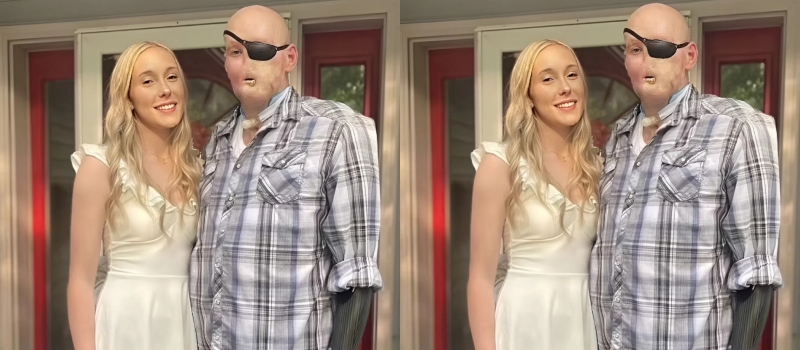
The accident was catastrophic. The powerful surge caused devastating injuries, destroying much of the left side of his face, severely damaging his arm, and costing him his eye. He lost his ability to smell and taste, and even simple movements like speaking or chewing became nearly impossible. Doctors were unsure whether he would survive the initial trauma. The first weeks blurred together in a haze of surgeries, intensive care, and overwhelming uncertainty.
Through it all, his wife of more than two decades, Meagan, remained by his side. At 39, she found herself navigating a new and heartbreaking reality. The man she had built a life with was still there in spirit, but physically altered in ways that were almost impossible to comprehend. Everyday moments—holding his hand, adjusting his pillow, helping him brush his teeth—carried both tenderness and grief. For nearly two years, Aaron relied on a liquid diet because chewing and swallowing were too difficult. Meagan whispered encouragement during the darkest days. “We’re going to get through this,” she would tell him, even when the future felt uncertain.
Then came a possibility that seemed almost unimaginable. A team at NYU Langone Health had assembled more than 140 medical specialists to attempt something never done before: a full face transplant that would include a donor eye. The surgery was groundbreaking and filled with risk. No one could guarantee success, and the complexity of transplanting an eye—with its delicate nerves and vascular structures—was staggering.
Aaron understood the stakes. “If this works, it’s bigger than me,” he told Meagan. “It could help so many people.” Then he added quietly, “And if I get to see you smile again, that’s everything.”
In May 2023, the marathon procedure began. Surgeons carefully transplanted bone, muscle, skin, blood vessels, and the donor eye. Every second mattered. Once separated from the donor, ocular tissues begin deteriorating quickly, so the surgical team worked with extraordinary precision to connect nerves and blood supply. They also used innovative techniques designed to encourage nerve regeneration. For 21 hours, the operating room was a coordinated effort of skill, focus, and hope.
When Aaron regained consciousness, the first thing he felt was Meagan’s hand wrapped around his. His voice was weak, but his request was clear. “Can you… kiss me?” he asked softly. When she leaned down and pressed her lips to his, emotion overcame them both. It was a simple gesture, yet after years of distance caused by injury and recovery, it felt miraculous. That first kiss marked a return—not just of physical connection, but of shared normalcy.
Aaron spent 17 days in intensive care, closely monitored for signs of rejection or complications. Against the odds, his recovery progressed steadily. Doctors were encouraged by the stability of the transplant and by early neurological signals suggesting activity in the visual pathways of his brain.
In September 2023, he returned home to Arkansas. Walking through his front door felt surreal. For the first time in years, he could eat solid food. Sitting at the kitchen table with Meagan, he bit into a slice of pizza and laughed. “This is what I’ve been fighting for,” he said, savoring flavors he had nearly forgotten.
Although he could not yet see clearly through the transplanted eye, medical scans revealed promising signs of brain response. Specialists remained cautiously optimistic that some degree of vision might eventually develop.
Life gradually settled into a new rhythm. Evenings were spent with Meagan and their daughter, enjoying quiet conversations and watching sunsets from the porch. Aaron began volunteering with veteran programs, determined to give back and encourage others facing adversity.
Yet something unexpected began to happen.
At first, it was subtle. One night, Aaron woke suddenly, thinking he had heard someone whisper his name. Meagan was asleep beside him. He brushed it off as a dream. But in the following days, he noticed fleeting impressions—brief flashes in his mind that felt unfamiliar. A woman laughing in bright sunlight. A child running through rain. A quiet room lined with books.
He hesitated to speak about it, unsure how it would sound. But eventually, he confided in Meagan. “It feels like memories,” he said carefully. “Not mine.”
Doctors conducted additional neurological tests, fascinated by unusual activity patterns. While science has long debated the concept of cellular memory, there had been no documented case like this. Researchers theorized that the brain, adapting to complex new neural input, might be interpreting signals in unexpected ways. Whatever the explanation, Aaron’s experience felt real to him.
He described it as a window—something both beautiful and overwhelming. “It’s a gift,” he told Meagan, “but it’s heavy sometimes.”
Over the following months, Aaron continued to improve physically. He began perceiving partial light and shadow through the transplanted eye. Each small advancement felt like a milestone. He and Meagan adapted together, finding gratitude in ordinary moments: shared meals, laughter in the living room, quiet morning coffee.
Still, curiosity lingered. Who had the donor been? What kind of life had they lived? Though donor identities remain confidential, Aaron felt a profound connection to the person whose final act of generosity had given him a second chance.
One rainy evening, as he watched droplets slide down the windowpane, he felt another vivid impression—an image so clear it startled him. He exhaled slowly, steadying himself. Rather than fear, he felt wonder. Medicine had already accomplished something extraordinary. Perhaps the mind, too, was capable of extraordinary adaptation.
Sitting beside Meagan, he squeezed her hand. “Whatever this is,” he said quietly, “we’ll face it together.”
For Aaron James, survival had once meant simply waking up each morning. Now, it meant rediscovery—of sensation, of connection, of purpose. His journey was not only a milestone in medical history but a testament to resilience, partnership, and the human capacity to endure.
The man who once risked his life on distant battlefields had fought an entirely different battle at home—and won. And in the gentle light of possibility, the future felt wider than ever before.