The bride collapsed in the middle of her wedding ceremony, and within hours, she was pronounced dead and transported to the morgue. It should have been the tragic end of a beautiful day, a story marked by grief and unanswered questions. But what happened next would challenge everything that seemed certain. A young morgue attendant noticed something unusual about the bride’s body—her cheeks still carried a faint rosy color, her skin didn’t feel cold, and deep inside, there was a rhythm that should not have been there.
That morning, an ambulance arrived at the building with its siren cutting through the quiet. Moments later, decorated cars adorned with white ribbons and flowers pulled into the courtyard. What should have been a celebration turned into confusion as a wedding procession came to a stop at the entrance of a morgue. Guests stood frozen, dressed in formal attire, some crying softly while others stared blankly, unable to process what had happened.
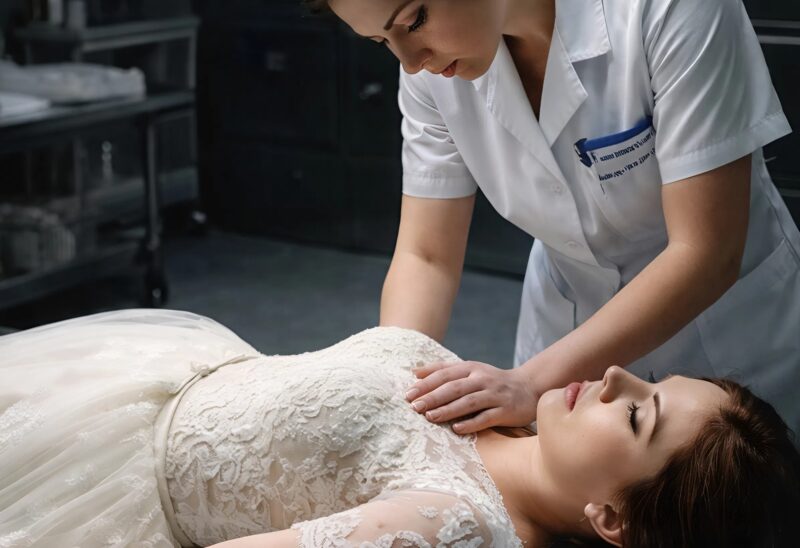
The bride was carried in on a stretcher, still dressed in her lace gown. Her hair was perfectly styled, and her bouquet rested gently on her chest as if nothing had changed. The groom walked beside her, silent and pale, his expression distant, as though he were watching someone else’s tragedy unfold.
The morgue attendant, who had only recently started working there, observed everything from the hallway. In the beginning, she had been frightened of her job, unsettled by the cold silence and sterile surroundings. But over time, she had learned to remain calm. She often remembered the chief doctor’s words: the truly dangerous people are not those who lie still, but those who walk around hiding their intentions.
Once the family was escorted away, the body remained alone in the examination room. The doctor quickly reviewed the paperwork and explained that the cause of death had already been determined. It was listed as poisoning, with all documentation properly signed. There was no reason for concern, he assured, and the autopsy would take place the following day.
When the room fell silent, the attendant approached the table. Something felt wrong. The bride looked too peaceful, too lifelike. Her skin wasn’t pale or gray, and her lips retained a natural tone. There was even a faint warmth in her cheeks.
Curious and uneasy, the attendant reached out and touched the bride’s hand. She quickly pulled back in surprise. The skin was warm.
Carefully, she tried again, this time pressing her fingers more gently. Beneath her touch, she could feel softness—something that did not belong to a lifeless body. She leaned closer, watching for any movement. For a moment, she thought she saw the slightest rise and fall of the chest.
Her breath caught.
Slowly, she lowered her ear to the bride’s chest. The room was completely silent, but then she heard it—a faint, almost imperceptible sound.
A heartbeat.
Startled, the attendant stepped back, her heart racing. If she was right, the bride was still alive. Without hesitation, she rushed out of the room and hurried down the corridor to find the doctor.
She told him everything in a breathless rush, insisting that the bride’s body was warm and that she had heard a heartbeat. The doctor, clearly irritated, followed her back to the room, though his expression suggested doubt.
He examined the bride carefully, checking her pulse, her pupils, and her chest. After a few moments, he straightened up and calmly explained that the body can retain warmth shortly after death. He suggested that what she heard might have been a reflex or a muscle contraction, something that can happen under certain conditions.
He reassured her that the official examination had already confirmed the absence of cardiac activity.
Still, the attendant couldn’t shake the feeling that something wasn’t right.
After the doctor left, she remained alone once again. Minutes passed. Then she noticed something subtle—the bride’s fingers twitched.
Her heart pounded as she leaned closer.
“Can you hear me?” she whispered softly.
There was no response.
For a moment, she wondered if fear was clouding her judgment. But deep down, she knew what she had seen and felt.
That night, instead of going home, she returned quietly to the morgue. She checked the body again. The warmth remained longer than it should have. That was when she made a decision.
Without telling anyone, she installed a small camera in the corner of the room, aimed directly at the examination table.
The next morning, she arrived early and locked herself in a nearby storage room to watch the recording.
For two hours, nothing happened.
Then, suddenly, there was movement.
The bride took a deep, sharp breath, as if emerging from underwater. Her fingers curled, and slowly, her eyes opened.
The attendant froze in disbelief.
Moments later, the door opened. The doctor entered, accompanied by the groom. Their voices were calm, almost casual, as if nothing unusual was happening.
Through the recording, the attendant heard the doctor explain that everything had gone according to plan. The dosage had been calculated precisely, ensuring that the bride would appear clinically dead. All the necessary documents had already been prepared.
The groom looked uneasy but urged him to hurry. They needed to leave before anyone discovered the truth.
Together, they helped the bride sit up. She was weak but conscious. They guided her out through a side exit, leaving no trace behind.
Watching the footage, the attendant finally understood.
There had been no accidental poisoning. The bride had been placed into a controlled, medically induced state that slowed her pulse to nearly undetectable levels. To anyone performing a routine examination, she would have appeared lifeless.
But there was a motive behind it all.
Days before the wedding, a large life insurance policy had been taken out in her name, with the groom listed as the beneficiary. In addition, she owned a significant share in her father’s business. Once declared dead, control would pass to him.
The plan had been carefully designed: collect the insurance, transfer the assets, and ensure the body was cremated quickly to avoid further investigation.
However, the recording revealed something unexpected.
The bride had known.
She had agreed to disappear, hoping to escape the pressures surrounding her life and start over somewhere far away.
But there was one thing they had not anticipated.
The attendant.
She saved a copy of the footage, holding onto the only proof that the truth was far more complicated than it appeared.